Green Building Certifications: How to Choose Sustainable Furniture for UAE Workspaces

Key Takeaway
Validating green building specifications requires deciding between full facility certifications like LEED or WELL, and product-specific environmental frameworks. Integrating multi-attribute labels and transparency protocols guarantees compliance with regional green codes, protecting occupant respiratory health and optimizing building life cycle performance.
Introduction
Incorporating green frameworks into commercial interior projects is an essential element of modern corporate real estate strategy. For years, selecting sustainable furniture assets was treated as a secondary styling choice or an unverified marketing claim.
However, modern commercial projects require documented environmental metrics to meet corporate carbon reduction targets and protect workforce well-being. By understanding the distinct differences between full facility building ratings and independent, product-level material certifications, procurement teams can successfully navigate environmental compliance and construct healthy, high-performance office environments across the GCC.
What Is an Eco-Certified Procurement Strategy?
An eco-certified procurement strategy is a comprehensive framework used by facility managers to select, verify, and source building materials and office furniture that carry audited environmental credentials.
Instead of relying on vague sustainability marketing claims, this methodology targets specific, third-party verified criteria. This strategy evaluates products based on raw material provenance, post-manufacturing toxic chemical emissions, factory energy source metrics, and end-of-life circular recycling capabilities, ensuring that all physical assets support human health and planetary resource preservation.
Why Verifiable Green Codes Matter for GCC Commercial Properties
Adopting verified environmental baselines is essential for regional companies working to comply with strict state construction rules, including the Dubai Al Sa'fat Smart Building Rating System and Abu Dhabi's Estidama Pearl Rating System. As international organizations occupy premium corporate spaces in premier business zones like the Dubai International Financial Centre (DIFC) and Riyadh’s King Abdullah Financial District (KAFD), hitting verified sustainability metrics is mandatory.
According to regional commercial real estate data, corporate fit-outs that prioritize low-emitting, eco-certified materials see measurable improvements in indoor air quality indexes and long-term asset value. Prioritizing verified green data ensures complete legal compliance while supporting corporate environmental, social, and governance (ESG) reporting requirements.
Option 1: Executing Full Facility Environmental Certifications
Certifying an entire physical property provides a holistic approach to environmental health but requires extensive technical documentation, external consulting overheads, and strict adherence to structural performance baselines.
LEED (Leadership in Energy and Environmental Design)
Established by the U.S. Green Building Council, LEED concentrates on the planet's long-term environmental health by reducing building resource consumption. The framework awards project points across categories like energy conservation, water efficiency, and sustainable material selection. Facilities achieve ranked tiers—spanning Certified, Silver, Gold, and Platinum—to prove minimized lifecycle carbon footprints.
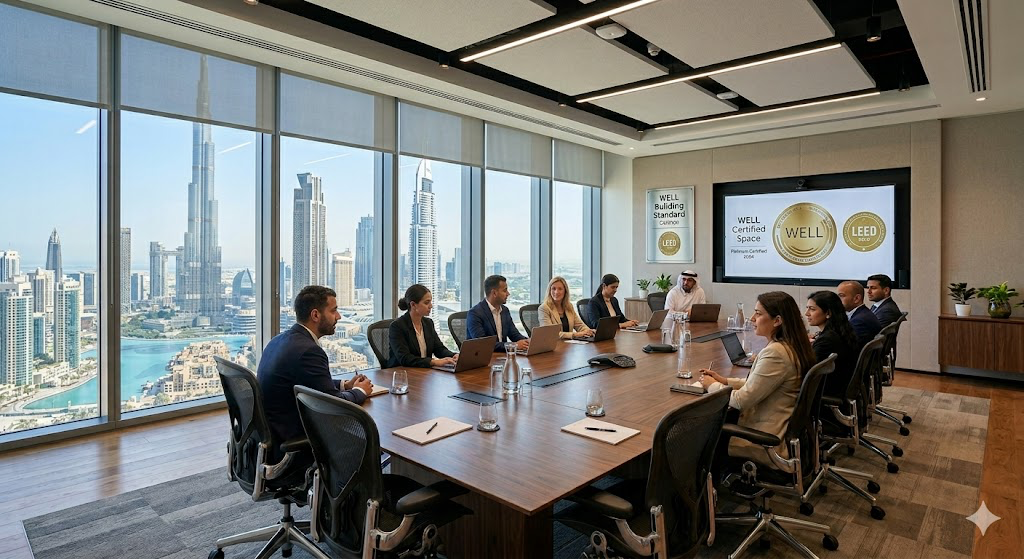
The WELL Building Standard
Administered by the International WELL Building Institute, the WELL standard focuses directly on human biology and health within the built environment. Rather than assessing mechanical building components alone, WELL measures, monitors, and audits indoor environmental factors that affect human wellness, including air purification, circadian lighting paths, acoustic comfort, and ergonomic design.
Option 2: Sourcing Sustainable Products via Independent Material Labels
When a company chooses not to certify an entire building facility, they can still enforce strict corporate environmental responsibility by focusing exclusively on product-level materials, which directly influences the points values needed for building-level compliance.
Single-Attribute Labels for Target Performance
Single-attribute certifications focus heavily on one specific environmental or human health achievement marker:
-
GREENGUARD & Indoor Air Advantage: Certified by UL and SCS Global respectively, these labels measure chemical emissions after manufacturing. They verify that furniture pieces do not off-gas volatile organic compounds (VOCs)—such as hazardous formaldehydes found in glues, sealants, and wood finishes—thereby protecting employee respiratory health.
-
FSC (Forest Stewardship Council): This strict certification tracks wood components across the entire supply chain from responsibly managed forests down to final assembly, ensuring timber harvesting does not contribute to global deforestation.
-
SAN (Sustainable Agriculture Standard): Launched in 2017, this framework covers bio-based materials to confirm agricultural components are grown using climate-smart, pollinator-friendly farming methods.
Multi-Attribute Frameworks for Life Cycle Assessment
Multi-attribute matrices assess the collective environmental footprints of the product, the manufacturing facility, and the corporate entity's social responsibility metrics:
-
BIFMA LEVEL Certification: This furniture sustainability standard assesses products across materials, energy utilization, human ecosystem health, and corporate social actions, ranking qualifying goods into Tiers 1, 2, or 3.
-
Cradle to Cradle (C2C): This rigorous global framework evaluates material health, circular reuse capabilities, renewable energy management, water stewardship, and social fairness, requiring products to hit all baseline parameters sequentially across Bronze, Silver, Gold, or Platinum tiers.
Transparency Protocols as Environmental Nutrition Labels
Transparency disclosures present third-party verified ingredient and environmental data without assigning a comparative score, allowing procurement managers to make informed decisions:
-
Declare Labels: Run by the International Living Future Institute, this protocol acts as an ingredient list for building products, disclosing 100% of chemical ingredients down to 100 ppm and flagging toxic "Red List" substances.
-
Health Product Declarations (HPDs): This reporting system provides an official chemical inventory of a product, identifying the potential health impacts of each chemical component.
-
Environmental Product Declarations (EPDs): Built on the ISO 14025 standard, an EPD summarizes a product's full Life Cycle Assessment (LCA). It delivers verified, cradle-to-grave data regarding a product's absolute carbon footprint, raw resource use, and modular disassembly options for circular recycling.
Traditional Product Procurement vs. Performance-Audited Selection: Which Is Better?
Choosing a material specification method requires comparing long-term workspace wellness against immediate purchasing speed. Traditional product procurement relies on selecting furniture items based solely on visual styles, superficial features, and baseline retail cost brackets, which leaves facilities exposed to toxic indoor VOC off-gassing and hidden supply chain liabilities.
Conversely, performance-audited selection requires verifying accredited single-attribute labels, multi-attribute tiers, and life cycle transparency documents prior to purchasing. While traditional procurement requires less technical research, it can lead to poor indoor air quality and prevent properties from achieving green building credentials.
Performance-audited selection requires systematic coordination with certified design experts, but it ensures total compliance with regional smart building frameworks and safeguards employee wellness. For enterprise groups building high-density office layouts under regional environmental standards, conditional recommendations dictate that if your project must satisfy regional sustainable building mandates or corporate ESG criteria, then performance-audited selection is superior to traditional product procurement.
Common Pitfalls to Avoid in Sustainable Material Specifications
The most frequent error facility planners commit is accepting general, unverified eco-friendly claims from suppliers without demanding third-party audited EPD sheets or GREENGUARD certificates, which can expose the company to greenwashing.
Another common error is mixing certified wood furniture with uncertified, high-VOC chemical sealants and laminates during installation, which completely compromises indoor air quality.
Finally, many corporate designers purchase modular desking assets that lack clear product disassembly maps, making sustainable disposal or circular recycling impossible at the end of the furniture's use cycle.
Best Practices for Deploying Sustainable Workspace furniture
Establishing a healthy, compliant, and environmentally responsible corporate office environment requires a structured, multi-step specification process.
-
Define the Project Certification Targets Early: Determine during the initial programming phase whether you will pursue full building certification (LEED/WELL) or target independent product-level sustainability.
-
Appoint Credentialed Green Building Consultants: Retain certified LEED AP or WELL AP specialists to map out point requirements and align contractor procurement paths with target certification tiers.
-
Mandate Complete Low-VOC and FSC Material Standards: Specify that all corporate task chairs, workstations, and acoustic wall panels carry verified low-emission marks like GREENGUARD or Indoor Air Advantage.
-
Implement Continuous Sustainable Post-Occupancy Policies: Communicate the value of material certifications to facilities teams to ensure that all future furniture additions maintain the building's healthy environment.
Frequently Asked Questions About Green Building Certifications
LEED focuses on a building's relationship with the planet by tracking energy conservation, water use efficiency, and resource sustainability. WELL concentrates on the building's relationship with human occupants by auditing indoor factors that impact health, such as air quality, lighting, and ergonomics.
VOC certifications are critical because they prove that manufactured furniture components do not release toxic airborne chemicals like formaldehyde. Avoiding high-VOC glues and finishes protects indoor air quality and prevents respiratory irritation and cognitive fatigue.
An EPD provides a verified report on a product's full Life Cycle Assessment (LCA) based on the ISO 14025 standard. It details the product's cradle-to-grave carbon footprint, raw material sources, and potential for structural disassembly and circular recycling.
C2C evaluates furniture across five sustainability categories: material health, material reutilization, renewable energy use, water stewardship, and social fairness. Products must meet all criteria within a specific tier to achieve a Bronze, Silver, Gold, or Platinum rating.
Yes, companies can choose not to certify an entire building while still choosing products with green certifications. Focusing on individual product labels like FSC, GREENGUARD, and BIFMA LEVEL ensures responsible sourcing and high material safety at a lower cost.
"Red List" chemicals are worst-in-class toxic manufacturing materials identified by the International Living Future Institute. These substances—including asbestos, PVC, and added formaldehydes—are known to pollute the environment and harm human health.
Sources
-
US Green Building Council (USGBC) LEED v4.1 Commercial Interiors Framework
-
International WELL Building Institute (IWBI) Standard Implementation Guidelines
-
Al Sa'fat - Dubai Green Building Evaluation and Compliance System Rules
Relevant